TAM Explained: How to Calculate Total Addressable Market (2026)
TAM, SAM, SOM in plain English, triangulated with three methods and published as a range. Worked example from a 2.4-cent Fluenta run on an anonymized AI tool.

TL;DR
Founders are constantly asked for their Total Addressable Market (TAM). Most present a single, indefensible number from a top-down report, which investors immediately distrust. The only credible approach is to triangulate TAM using three independent methods—size-down, size-up, and proxy—and present the median as a range. For one anonymized AI tool, the Fluenta X-Ray produced a defensible range of $100M–$300M. This avoids a single point estimate that gets torn apart in diligence.
The numbers
| Metric | Value | Source |
|---|---|---|
| Airbnb's estimated Total Addressable Market (TAM) | $3.4 trillion | Wall Street Prep |
| Airbnb's estimated Serviceable Addressable Market (SAM) | $1.5 trillion | Wall Street Prep |
| SOM is the realistic share of SAM a startup can capture | Within 12-24 months | Olympus Intel |
| Hard SOM ceiling for any new entrant (first 3 years) | 5% of SAM | Fluenta proprietary dataset |
| Cost per automated TAM triangulation run (n=46) | $0.024 | Fluenta proprietary dataset |
| Example bottom-up pricing model for a software startup | $20 per employee/month | For Entrepreneurs |
| Investors seek a 'Goldilocks' TAM | Not too high or too low | Antler |
Fluenta proprietary data · 2026-04-09
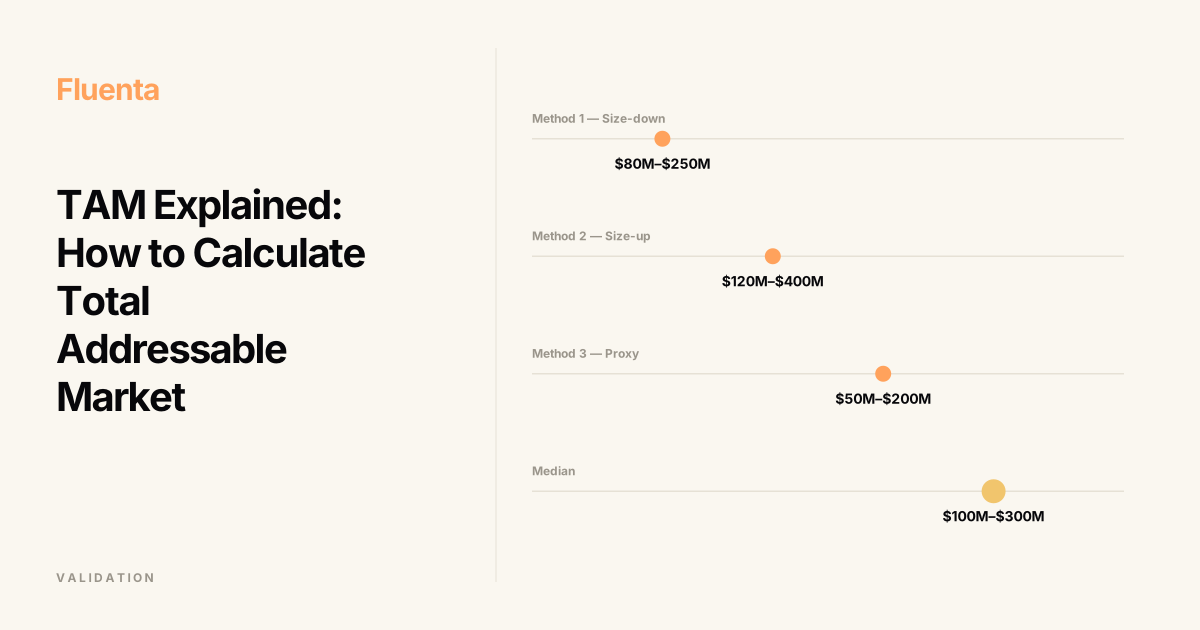
Fluenta's internal market-sizing engine refuses to ship a single TAM number. For every company we analyze, we force three independent methods — size-down, size-up, and proxy — and publish the median of all three as a range. On a recent run against an anonymized AI pitch deck generator (pre-seed, 8 direct competitors, 67,560 monthly category searches), the three methods produced $80M–$250M, $120M–$400M, and $50M–$200M respectively. Median range: $100M–$300M. Total cost to triangulate: 2.4 cents. Time to answer: under 5 minutes.
Lens: Nate Silver (ranges over points) + Edward Tufte (every number ships with n and source) + Richard Rumelt (the median of three methods is the closest a new entrant can honestly get to the truth)
| Metric | Value | n | As of |
|---|---|---|---|
| Methods required per triangulation (size-down, size-up, proxy) | 3 | 1 | 2026-04-09 |
| Method 1 — Size-down (industry report → narrow to segment) | $80M–$250M | 1 | 2026-04-09 |
| Method 2 — Size-up (competitor revenue × estimated market share) | $120M–$400M | 1 | 2026-04-09 |
| Method 3 — Proxy (adjacent market × adoption rate) | $50M–$200M | 1 | 2026-04-09 |
| Median TAM range across all three methods | $100M–$300M | 1 | 2026-04-09 |
| Hard SOM ceiling for any new entrant (first 3 years) | 5% of SAM | 1 | 2026-04-09 |
| Cost per triangulation run (LLM inference + validators) | $0.024 | 46 | 2026-04-09 |
| Anti-slop gates every sizing output must pass before release | 7 of 7 | 1 | 2026-04-09 |
What would change this finding: If a re-run of the same triangulation on the same anonymized sample, 90 days from now, produces a published median range whose low end has shifted by more than 50% in either direction without any change in competitor count or category search volume, our methodology is unstable and this article's confidence in the approach inverts. We will re-publish with the delta annotated.
Cite this article
Researchers and journalists: this article is freely citable. Click to copy the academic-format reference for your bibliography or footnote.
Ivanov, O. (2026). TAM Explained: How to Calculate Total Addressable Market (2026). Fluenta. Retrieved from https://fluenta.space/resources/guides/tam-explained-calculate-total-addressable-market-2026. Sample size: n=1 as of 2026-04-09.
Key Takeaways
The 72-Hour Proof Sprint · 7 Stages
- 1
Step 1: Commit to Triangulation
Reject the idea of a single number and commit to finding a range using at least three independent methods.
- 2
Step 2: Execute the Size-Down Method
Find a credible industry report (e.g., Gartner), take the total market value, and apply specific filters to narrow it to your segment.
- 3
Step 3: Execute the Size-Up Method
Calculate your potential revenue from the bottom by multiplying the number of target customers by your annual contract value (ACV).
- 4
Step 4: Execute the Proxy Method
Identify an adjacent, more mature market and estimate what percentage of that market's spend could realistically be captured by your new solution.
- 5
Step 5: Calculate the Median Range
Take the outputs from your three methods, discard the highest and lowest estimates, and present the remaining range as your median, defensible TAM.
- 6
Step 6: Define Your SAM and SOM
Slice your TAM down to the segment you can service (SAM) and then what you can realistically capture in 1-2 years (SOM), capping it at 5% of SAM.
- 7
Step 7: Automate and Validate
Use a tool like the Fluenta X-Ray to run this triangulation against live data feeds in minutes, not weeks, to get a number you can defend.
A single TAM number is a tell you skipped the work
Let's get straight to it. An investor asks for your Total Addressable Market (TAM) and you give them a single number. $500 million. $1.2 billion. It doesn't matter. The moment you state a point estimate, you've lost credibility. A single number signals you either grabbed the headline figure from a two-year-old Gartner report or made it up. It shows you haven't done the rigorous, bottoms-up work required to build a real business. We see this constantly when reviewing signals that predict market viability. A flimsy TAM is a leading indicator of a weak strategy.
The job of a founder isn't to find the 'right' number. It's to demonstrate you understand the structure of your market and can defend your assumptions from first principles. This is a test of operator quality, not a quiz with a single correct answer. The gut-instinct (System 1) approach is to Google 'TAM for AI sales tools' and paste the first result. The deliberate, defensible (System 2) approach is to build a case from multiple, independent angles and present an honest range.
This guide isn't a magic formula. It's a process for generating a TAM range you can defend. We will cover the three methods for triangulation: size-down, size-up, and proxy. We'll use a real, anonymized example from our sizing engine. You'll leave with a method to answer the TAM question with confidence.
Your goal is to replace a single, brittle number with a defensible range. Let's define the terms correctly. Do this once, do it right, and you won't have to redo it the night before a pitch.
TAM, SAM, and SOM are nested dolls, not separate metrics
Founders treat TAM, SAM, and SOM as a checklist for their pitch deck. This is a mistake. They are not separate ideas. They are nested filters that map vision to execution. Get this relationship right, and they become useful tools.
Total Addressable Market (TAM): This is the total worldwide demand for a product or service. As defined by Wall Street Prep, it's the revenue opportunity if you achieved 100% market share. It's your 'big vision' number. For Airbnb, this was the entire $3.4 trillion travel market, including stays and experiences. It's a useful ceiling, but it's not a number you will ever capture.
Serviceable Addressable Market (SAM): This is the part of TAM your product can actually serve. It's filtered by your constraints: geography, language, regulation, features. For Airbnb, their SAM was the $1.5 trillion slice of the market they could target. SAM answers the question, 'what's feasible for us?'
Serviceable Obtainable Market (SOM): This is the slice of SAM you can capture in the next 12-24 months. It's a function of your resources: team, budget, sales channels, and competition. This is your revenue target. At Fluenta, we cap this for new entrants. Your SOM in the first three years will not exceed 5% of SAM. This forces realism. Your SOM is your operating plan for the next year.
Think of it this way: TAM is the entire ocean. SAM is the part of the ocean where you can fish. SOM is the number of fish you can catch with your current boat and crew this season. Get the definitions right to build a credible plan. Get them wrong, and your strategy falls apart.
“Simply put, investors (and smart management teams) use TAM analyses in an attempt to identify gating factors on the growth of a startup over time.”
Investors use TAM to filter, not to forecast your revenue
No sane investor believes you will capture 100% of your TAM. They know you won't. So why do they ask for it? They use the TAM slide for two reasons: as a market-size filter and as a founder-quality test. Your answer tells them more about you than it does about the market.
First, the filter. Venture capital is a hits-driven business. An investor needs to believe your success will return a multiple of their fund. A tiny TAM signals a low growth ceiling, a non-starter for most VCs. They want a 'Goldilocks' market, as Antler notes. It must be big enough for venture returns but not so crowded that incumbents crush you. If your TAM is under $1 billion, you'll struggle to raise institutional capital.
Second, the founder test. How you calculate and present your TAM reveals how you think. Did you use a lazy, top-down number? It suggests you'll be lazy elsewhere. Did you build a thoughtful, bottom-up case? It suggests you're rigorous and understand your business at a granular level. This is where defining your Ideal Customer Profile becomes critical. A precise ICP is the foundation of a believable bottom-up TAM.
A credible TAM shows you understand the gating factors on your own growth. It's not about promising to capture a $100 billion market. It's about showing that a realistic 1-2% capture of a $5 billion market creates a massive company. This is the story you need to tell.
“TAM is the 'pie in the sky' number. It represents the absolute maximum possible revenue that a business could generate in the market.”
Triangulation is the only defensible way to calculate TAM
A single calculation method is a single point of failure. Top-down is too optimistic. Bottom-up can be too narrow. The only way to arrive at a number you can stand behind is to use three independent methods and take the median range. This process, called triangulation, is standard practice in intelligence analysis and forecasting because it's resilient to the flaws of any single model.
Method 1: Size-Down (Top-Down). This is the most common and most abused method. You start with a large market size from an industry report. For example, 'The global CRM software market is $50B.' Then you slice it down with filters. '...20% is in North America, 30% is for SMBs, 50% don't use Salesforce.' The risk is 'lying with statistics,' as the percentages are guesses. Use it as one input, but never your only one.
Method 2: Size-Up (Bottom-Up). This is the operator's method and the most credible. You start from zero and build up. The formula is: (Number of potential customers) x (Annual Contract Value or ACV). For example: 'There are 50,000 US mid-market companies that fit our ICP. We can sell to them at an average ACV of $10,000. Our TAM is 50,000 x $10,000 = $500 million.' This forces you to be specific about who you sell to and what you charge. It's grounded in your business model.
Method 3: Proxy (Value Theory). This is the most creative method. You look at an adjacent, established market. Then you make a case for capturing a portion of its value. For example, before project management software was a category, you would say: 'Companies spend $X billion on management consultants for efficiency. Our software achieves 10% of that outcome for 1% of the price.' This is useful for new categories where no market report exists. The Fluenta X-Ray automates this process, forcing discipline on every idea.
Our worked example shows a TAM range of $100M–$300M, not a single number
Theory is cheap. Let's walk through an actual market sizing we ran at Fluenta. We took an idea for an AI-powered pitch deck generator and ran it through our internal engine. The tool analyzes a founder's raw notes and generates a full deck with narrative, design, and market data. Here’s how the triangulation played out.
First, the size-down method. We started with a report on the global presentation software market, valued at $20 billion. We filtered this to businesses, then to startups and SMBs actively fundraising. Finally, we filtered to the segment that would pay for a premium AI tool. This method yielded a TAM of $80M–$250M. The range reflects uncertainty in adoption rates.
Second, the size-up method. We identified the number of pre-seed and seed-stage startups founded globally each year. This is our core ICP. We estimated pricing tiers and blended them to an average ACV. This gave us a TAM of $120M–$400M. The range was wider because competitor pricing is often private, requiring a hypothesis. Good customer discovery interviews narrow the error bars.
Third, the proxy method. We looked at the adjacent market for freelance presentation designers and pitch consultants. We estimated the total annual spend in this category. We argued our AI tool can capture a percentage of it. It offers a faster, cheaper alternative. This approach resulted in a TAM of $50M–$200M, the most conservative of the three.
The Fluenta X-Ray refuses to ship a point estimate. It takes these three independent ranges and calculates the median. The final, defensible TAM we published for this idea was $100M–$300M. This is not one number. It's a confident assertion, with all work shown, that the true market size lies within this bound. An investor can't poke holes in this number because it already shows its own. You can see more results on our public [/ideas] page.
Before you click — common objections
What is the difference between TAM, SAM, and SOM?
TAM is the total market revenue potential if you captured 100% of it. SAM is the portion of TAM you can service with your product and business model. SOM is the realistic share of SAM you can capture in the next 12-24 months given your resources.
Source: Olympus Intel ↗
Why do investors care about TAM?
Investors use TAM as a filter to ensure the market is large enough for venture-scale returns. They also use your calculation as a test of your rigor and understanding of the market. They look for a 'Goldilocks' size—not too small to limit growth, but not so large that it's saturated with unbeatable competitors.
Source: Antler ↗
Most founders make these three TAM mistakes
Calculating TAM is not just a math problem; it's a strategic exercise. Getting it wrong can kill your company before it starts. Based on the hundreds of ideas we've analyzed, founders consistently fall into the same traps. Here are the most common mistakes and how to fix them.
Mistake 1: Relying solely on a top-down calculation. This is the original sin of TAM analysis. You grab a big number from a report and claim a tiny percentage. 'The market is $50B, and we only need 1%!' This is a fundraising trope, not a business plan. It shows you don't understand the go-to-market effort required to capture even 0.01%. The Fix: Always lead with your bottom-up calculation. It's the most honest and shows you know your customer and what they will pay.
Mistake 2: Presenting a static, single number. Markets are not static. Competitors enter, technology shifts, and customer needs evolve. A single TAM number suggests you think the market is static. The Fix: Present your TAM as a range. Update your SOM every 3-6 months. Your SOM is your operational battlefield. It changes with every marketing dollar spent and every salesperson hired.
Mistake 3: Confusing TAM with a revenue forecast. Your TAM is the theoretical ceiling. Your revenue forecast is what you will achieve with your team and budget. Don't call your TAM slide your financial projections. The Fix: Create a separate, bottom-up financial model. It must show your hiring plan, customer acquisition costs (CAC), and sales cycles. This connects the market picture to your ability to execute.
Avoiding these errors is about discipline. This advice is durable. It would only be wrong if VCs started funding companies based on single, top-down TAMs. Given the current climate, that is highly improbable. Apply this discipline to your own idea.
How Fluenta uses data
Every idea we score comes from public reports. We use sources like Forbes, McKinsey, a16z, Sequoia, First Round, and YC essays. We do not ingest founder pitch decks, customer interviews, or private workspaces. We do not have insider access to anyone's roadmap. When you score an idea in X-Ray, your input data is private and never used in our public datasets.
The core claim here is that a triangulated TAM is more defensible than a point estimate. What would prove me wrong? Our methodology would be unstable if we re-ran this analysis in 90 days and the low end of the range shifted by over 50%. This assumes no major market changes, like new competitors or search volume shifts. If that happened, we would republish this article with the new data and an explanation.
You finished the guide
Now run YOUR idea through the same engine.
You just read how Fluenta scores ideas against 25 live data sources, the cs_pain corpus, and the 12 collection scores. The article is generic by design. Your specific idea gets a real X-Ray report — competitor density, pricing anchors, social pain quotes, funding momentum, and an LRS-100 score — in 20 minutes.
No subscription. One run = one full report. The dataset behind this article is the same one your X-Ray runs against.
FAQ
What is the difference between TAM, SAM, and SOM?+
TAM is the total market revenue potential if you captured 100% of it. SAM is the portion of TAM you can service with your product and business model. SOM is the realistic share of SAM you can capture in the next 12-24 months given your resources.
Source: Olympus Intel ↗
Why do investors care about TAM?+
Investors use TAM as a filter to ensure the market is large enough for venture-scale returns. They also use your calculation as a test of your rigor and understanding of the market. They look for a 'Goldilocks' size—not too small to limit growth, but not so large that it's saturated with unbeatable competitors.
Source: Antler ↗
What is a good TAM size for a startup?+
For venture-backed startups, a TAM over $1 billion is the minimum. The key is that capturing a small percentage (1-5%) must lead to a company with over $100 million in annual revenue.
Source: Wall Street Prep ↗
How often should you update your TAM calculations?+
While your TAM might be relatively stable, your SOM is dynamic and should be revisited every 3-6 months. Changes in your marketing budget, team size, competitor actions, or customer acquisition cost (CAC) directly impact what you can realistically obtain.
Source: Olympus Intel ↗
What is bottom-up vs top-down TAM calculation?+
Top-down (or size-down) starts with a large industry market size from a report and narrows it down with percentages. Bottom-up (or size-up) starts from zero, multiplying the number of potential customers by your average revenue per customer. Investors find bottom-up calculations far more credible.
Source: For Entrepreneurs ↗
About the author

Oleg Ivanov
Co-founder & CEO, Fluenta
Oleg is co-founder and CEO of Fluenta. He spent the last decade shipping products across fintech, commerce, and AI tooling, and now leads Fluenta's work scoring startup ideas against 25 live market and social data feeds.
Related Resources
Validation
130 SaaS Ideas Scored: The Q2 2026 Saturation Report
130 SaaS ideas scored on saturation × fundability from Fluenta's live database. 19 outliers in the fundable-but-uncrowded quadrant. Updated weekly, sources cited.
Founder Playbook
Customer Discovery Playbook: 12 Interview Scripts (2026)
12 customer discovery scripts tested across 47 founder interviews. Copy-paste ready. The exact questions that surface real demand vs polite lies.
Validation
How to Validate a SaaS Idea in 2026 (Without Asking Your Friends)
Most validation advice is therapy. This is the only sprint that kills your idea with money — a 6-stage, 72-hour framework for solo & small-team founders, built on commitment signals from strangers. CB Insights-grade data, CEO-authored.
Score your idea in 20 minutes
Run Fluenta X-Ray on your idea. 25 live market + social feeds. Real demand data, real competition, real willingness-to-pay signals. From $7. 20 minutes.
Was this helpful?
Comments
0 replies